TMS works by delivering targeted magnetic pulses to areas of the brain that help regulate mood — regions that can be underactive in depression. The idea is simple, but the way it’s done is precise and personalized. Here’s what actually happens, from the science to your daily sessions.
The Science, in Plain Language
Depression is associated with reduced activity in certain mood-regulating regions of the brain, particularly an area called the dorsolateral prefrontal cortex. Transcranial magnetic stimulation uses a magnetic coil — producing a field similar in strength to that of an MRI machine — to send brief, focused pulses to those regions. As the National Institute of Mental Health describes it, repetitive TMS (rTMS) uses an electromagnet to deliver repeated low-intensity pulses that induce small electrical currents in the targeted neurons.
Over a series of sessions, this repeated stimulation is intended to help restore healthier patterns of brain activity. Think of it less like flipping a switch and more like consistent training: the repetition, delivered to the same precise location day after day, is what the treatment is built around. You can read NIMH’s overview of how brain stimulation therapies work for the federal explanation.
Because the pulses are focused on a specific area, the rest of your body isn’t affected the way it can be with medication that circulates through your bloodstream. That focus is also why mapping — the step that pinpoints exactly where and how strongly to treat — matters so much. It’s the difference between a generic setting and one calibrated to you.

Step One: Your Mapping Appointment
Your first treatment visit isn’t a full session — it’s a mapping appointment, and it sets the foundation for everything that follows. During mapping, your provider locates your individual motor threshold: the lowest level of stimulation needed to produce a small, visible response, usually a slight twitch in your hand. This gives your provider an objective, personalized reference point for how much energy your treatment should use.
Your provider also identifies the precise position on your head where the coil should sit to reach the targeted brain region. Because everyone’s anatomy is a little different, this step is what makes the daily sessions that follow accurate and consistent. Once your settings are established, they guide your full course of care, though your provider can adjust them over time based on how you respond.
Mapping typically takes a bit longer than a routine session, and it’s completely non-invasive — no needles, no sedation, nothing implanted. You’re awake and involved the whole time, and you can ask questions as you go. By the end, you and your care team have a treatment plan tailored specifically to you.
Wondering if TMS could be right for you?
Your provider and TMS team determine eligibility. Individual responses vary.
What a Treatment Session Looks Like
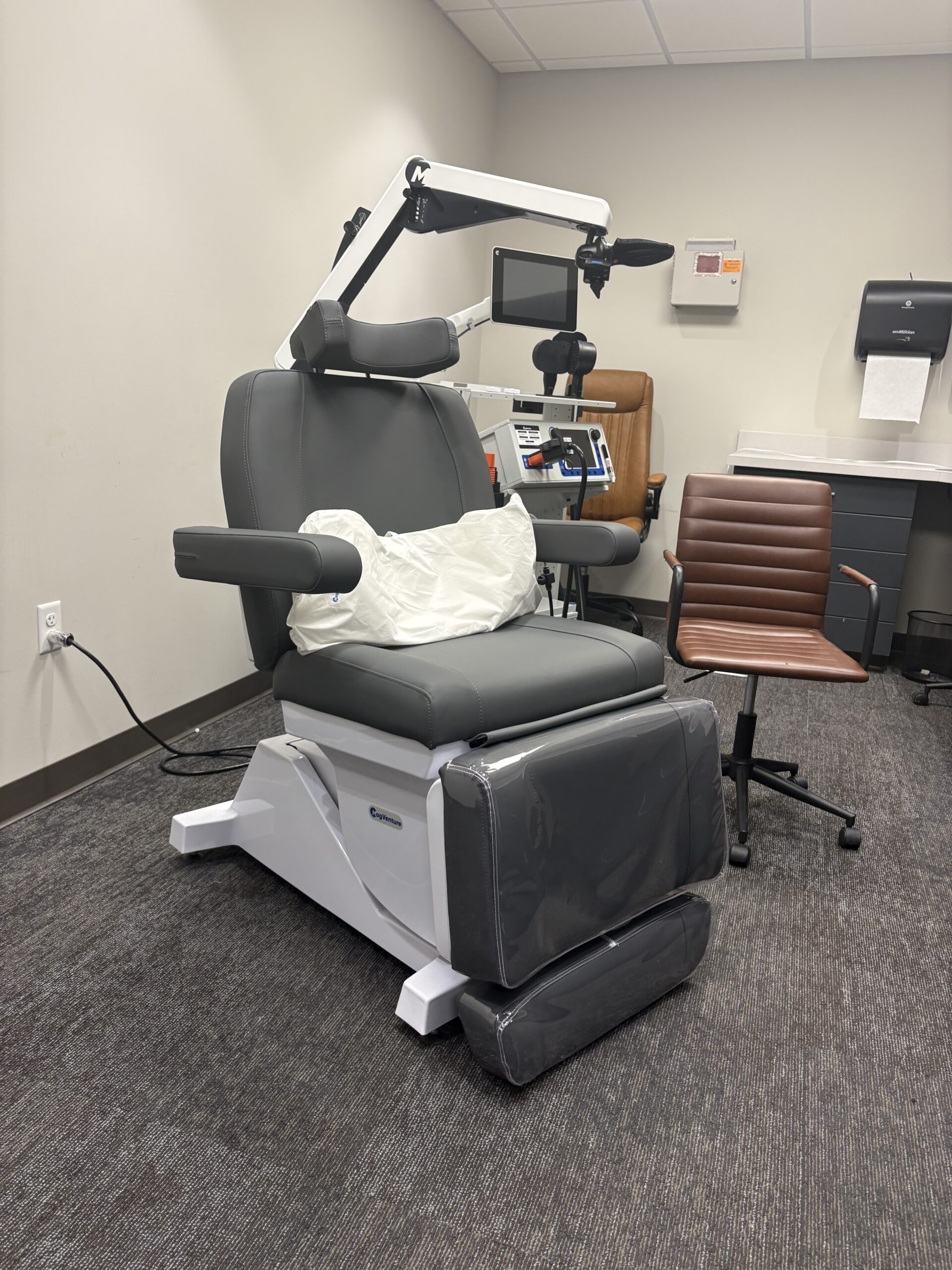
A typical TMS session is short and routine. You relax in a treatment chair while the coil is positioned against your scalp at the spot your provider mapped. When treatment begins, you’ll hear a clicking sound and feel a tapping sensation on your head as the pulses are delivered. It’s an unusual feeling at first, but most people get used to it quickly, and any scalp discomfort tends to ease over the first week of treatment.
You stay awake and alert the entire time. There’s no anesthesia and no sedation, so many people read, listen to music, watch something, or simply rest. When the session ends, there’s no recovery period — you can return to work, errands, or home, and you can drive yourself to and from your appointments. That convenience is one of the reasons TMS fits into everyday life more easily than many people expect.
Throughout your course, your provider monitors how you’re doing, both through standardized symptom tracking and ongoing check-ins. TMS isn’t a hands-off, set-it-and-forget-it treatment; it’s an active, monitored process where your responses guide the plan.
Standard TMS and Theta Burst Stimulation
Discovery Texas Interventional Psychiatry uses the MagVenture TMS system, which supports both standard TMS and Theta Burst Stimulation (TBS). The two approaches use different pulse patterns. Standard rTMS delivers pulses in a steady, established rhythm, while Theta Burst delivers them in short, rapid bursts that can shorten the length of a session considerably. Both are forms of the same underlying treatment; the difference is timing and delivery, not a different procedure.
Your provider recommends the approach that’s most appropriate for you, taking into account your clinical picture, your schedule, and your insurance authorization. Newer pulse patterns like TBS are part of why brain stimulation therapy has become more accessible over time, a trend NIMH notes in its discussion of evolving brain stimulation approaches.
Your Treatment Course
A typical TMS course involves a series of sessions delivered over several weeks, most often on weekdays. Many treatment plans run roughly five days a week for about four to six weeks, though the exact number of sessions varies based on your provider’s recommendation, your progress, and what your insurance authorizes. Some plans also taper sessions gradually toward the end rather than stopping abruptly.
It’s worth setting expectations honestly: TMS is a commitment of time, and consistency matters because the repetition is part of how it’s designed to work. Results vary from person to person, and your provider will track your progress throughout so that decisions are based on your response rather than a fixed schedule. To see how this connects to the rest of your care, visit our What to Expect page.
After Your Course: Tracking and Follow-Up
Finishing your initial course of sessions isn’t the end of the conversation. Your provider reviews how your symptoms have changed using standardized measures and discusses next steps with you, which may include continued monitoring, coordination with your other treatments, or a follow-up plan. Because depression can fluctuate, some people benefit from periodic check-ins after their main course concludes.
The goal throughout is the same one you started with: durable improvement that’s measured, not assumed. If symptoms return or shift over time, your care team can talk through options rather than leaving you to figure it out alone. That continuity is part of what it means to treat TMS as a serious medical treatment, not a quick fix.
Key Terms
Magnetic Coil
The device that rests against your scalp and generates the magnetic field used to stimulate the targeted brain region. It produces a field similar in strength to an MRI.
Pulse
A single, brief burst of magnetic energy. TMS delivers many pulses in patterns during a session to stimulate nerve cells in the targeted area.
Motor Threshold
The lowest stimulation level that produces a small muscle response, used during mapping to personalize the strength of your treatment.
Session
A single TMS treatment appointment, during which pulses are delivered to the mapped location while you sit awake in a treatment chair.
Treatment Course
The full series of sessions that make up your TMS treatment, typically delivered over several weeks and guided by your provider’s recommendation.
Theta Burst Stimulation (TBS)
A pulse pattern that delivers stimulation in short, rapid bursts, often in a shorter session than standard TMS. The MagVenture system supports TBS.
Helpful Resources
- NIMH — Brain Stimulation Therapies: How rTMS and related treatments work, in plain language from the National Institute of Mental Health.
- MedlinePlus — Depression: Patient-friendly information on depression and its treatments, including rTMS, from the U.S. National Library of Medicine.
- NIMH — Depression: Background on the condition rTMS is used to treat.
- U.S. Department of Veterans Affairs — Neuromodulation Clinic: An example of how rTMS is delivered within a major health system.
Frequently Asked Questions
How long is each TMS session?
Session length depends on the approach your provider recommends. Standard TMS sessions and Theta Burst sessions differ in length, with Theta Burst generally being shorter. Your team will tell you what to expect for your specific plan.
What does a TMS session feel like?
You’ll hear a clicking sound and feel a tapping sensation on your scalp as the pulses are delivered. Some people notice mild scalp discomfort at first, which usually eases within the first week. You stay awake and alert throughout.
What is the mapping appointment for?
Mapping locates your individual motor threshold and the exact coil position for your treatment, so your daily sessions are personalized and consistent. It’s a non-invasive step done at your first treatment visit.
How many TMS sessions will I need?
A typical course runs over several weeks, often around four to six weeks of weekday sessions, but the exact number varies based on your provider’s recommendation, your progress, and your insurance authorization. There is no single fixed number that applies to everyone.
Can I drive myself to and from sessions?
Yes. TMS does not require sedation or anesthesia, so there are no restrictions on driving before or after your appointments. Most people continue their normal daily activities throughout treatment.
Is standard TMS or Theta Burst better?
Neither is universally “better” — they are different delivery patterns of the same treatment. Your provider recommends the approach that best fits your clinical needs, schedule, and insurance authorization.